Worth remembering
- A sumo beya is a live-in training house, not a gym you drop into. Under the Nihon Sumō Kyōkai there are 47 stables training nearly 700 wrestlers.[1]
- Morning practice typically begins between 5:00-7:30 AM and continues for 2-4 hours, and the exact start time varies by stable and season.[2]
- The sumo dohyō has a diameter of 14.93 feet (4.55 m).[3] Once the wrestlers collide, sumo bouts last 20-30 seconds.[4]
- The Tokyo: Sumo Entertainment Show with Chicken Hot Pot & Geisha runs 2 hours, from US$102 and rated 4.79 from 8,004 reviews.[5]
- Free cancellation: Cancel up to 24 hours in advance for a full refund, and you can reserve now & pay later.[5]
- Top choice Sumo show, hot pot & geisha from US$102 Rating4.79 from 8,004 reviews[5]Duration2 hours[5]Good to knowSmall group available[5]CancellationFree cancellation up to 24 hours before[5] Check availability
- Family sumo workshop, lunch from US$62 Rating4.90 from 430 reviews[6]Duration2 hours[6]Good to knowSkip the line through a separate entrance[6]CancellationFree cancellation up to 24 hours before[6] See this tour
- Ginza sumo show & photo from US$61 Rating4.57 from 1,459 reviews[7]Duration1.5 hours[7]Good to knowWheelchair accessible[7]CancellationFree cancellation up to 24 hours before[7] See this tour
Under the Nihon Sumō Kyōkai, the association that governs the sport in Japan, there are currently 47 stables training nearly 700 wrestlers.
Is a Tokyo Sumo Stable Visit Worth Your Morning?
Read before booking
On the day
- Layer up: training halls are cold at dawn and warm once the room fills.
- Bring water and a quiet snack, since meals come after the session ends.
- Keep phones silent, no flash, no eating, and stay seated on the tatami.
- Carry some cash for drinks and souvenirs around Ryogoku afterwards.
What a Sumo Beya Actually Is
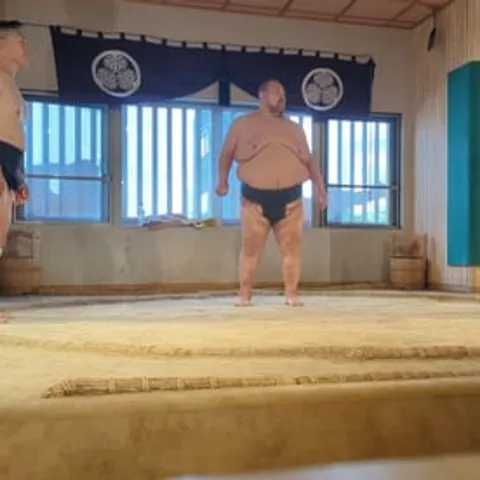
A sumo beya is a working house, not a gym you drop into. Wrestlers live there, eat there and train there under a stable master, and the dohyo sits in the middle of the training room with everything else arranged around it. Rank decides almost everything indoors: who eats first, who washes up, who fetches and carries for the senior men. Visitors are guests in a home, so shoes come off at the entrance, voices stay low and you sit still on the tatami while the session runs. That quiet pressure is the thing you remember.
Stables are scattered across Japan, with a cluster in Ryogoku, the Tokyo district around the Kokugikan arena, where you can walk between several addresses in a morning. You cannot simply knock on a door and ask to watch. Access comes through an organised visit, usually an early practice tour with a guide who knows the house rules, or through a public show where retired wrestlers demonstrate the sport in a hall built for audiences. Under the Nihon Sumō Kyōkai, the association that governs the sport in Japan, there are 47 stables training nearly 700 wrestlers.[1]
Morning Practice: What You Will Watch
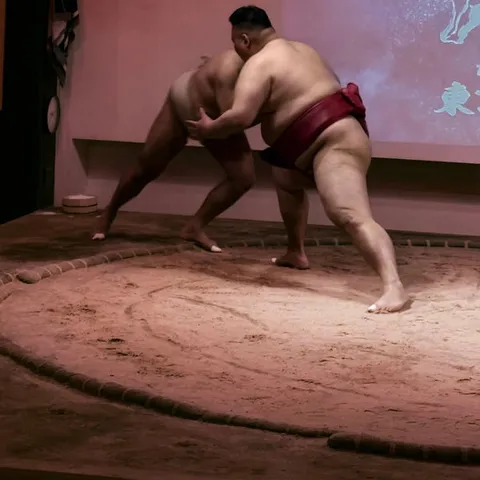
Asageiko is the session visitors ask about most. It is repetitive, slow to build and physically punishing. Wrestlers stretch and warm up, slap their own bodies, then take turns charging into each other, again and again, with short breaks to breathe. The thud of two heavy bodies colliding carries across the room and through the floor. Nobody performs for the guests and nobody explains what is going on, which is where a guide earns their fee. You are watching a working day, not a rehearsal for one.
Morning practice typically begins between 5:00-7:30 AM and continues for 2-4 hours, and the exact start time varies by stable and season.[2] That shapes the whole day around it. You will be up before the trains get busy, standing outside a quiet building in the half light, and finished in time for a late breakfast. Dress in layers, because the hall is cold at dawn and warm once bodies fill it, and expect to sit on the floor for the whole session.
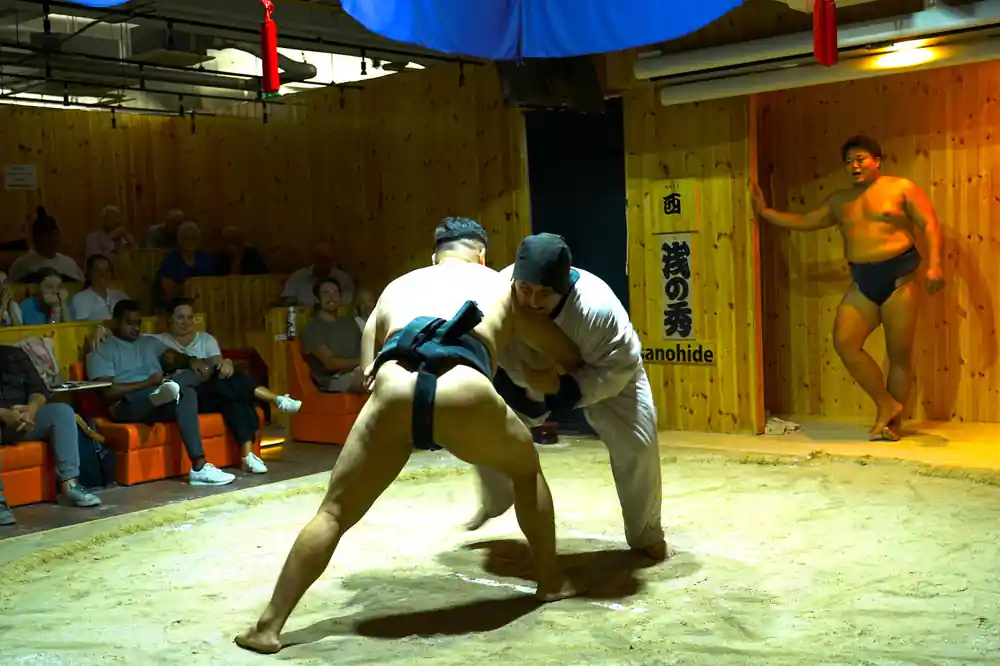
Wrestlers crouch and set their grips before the charge
The Dohyo, the Rules and the Ring
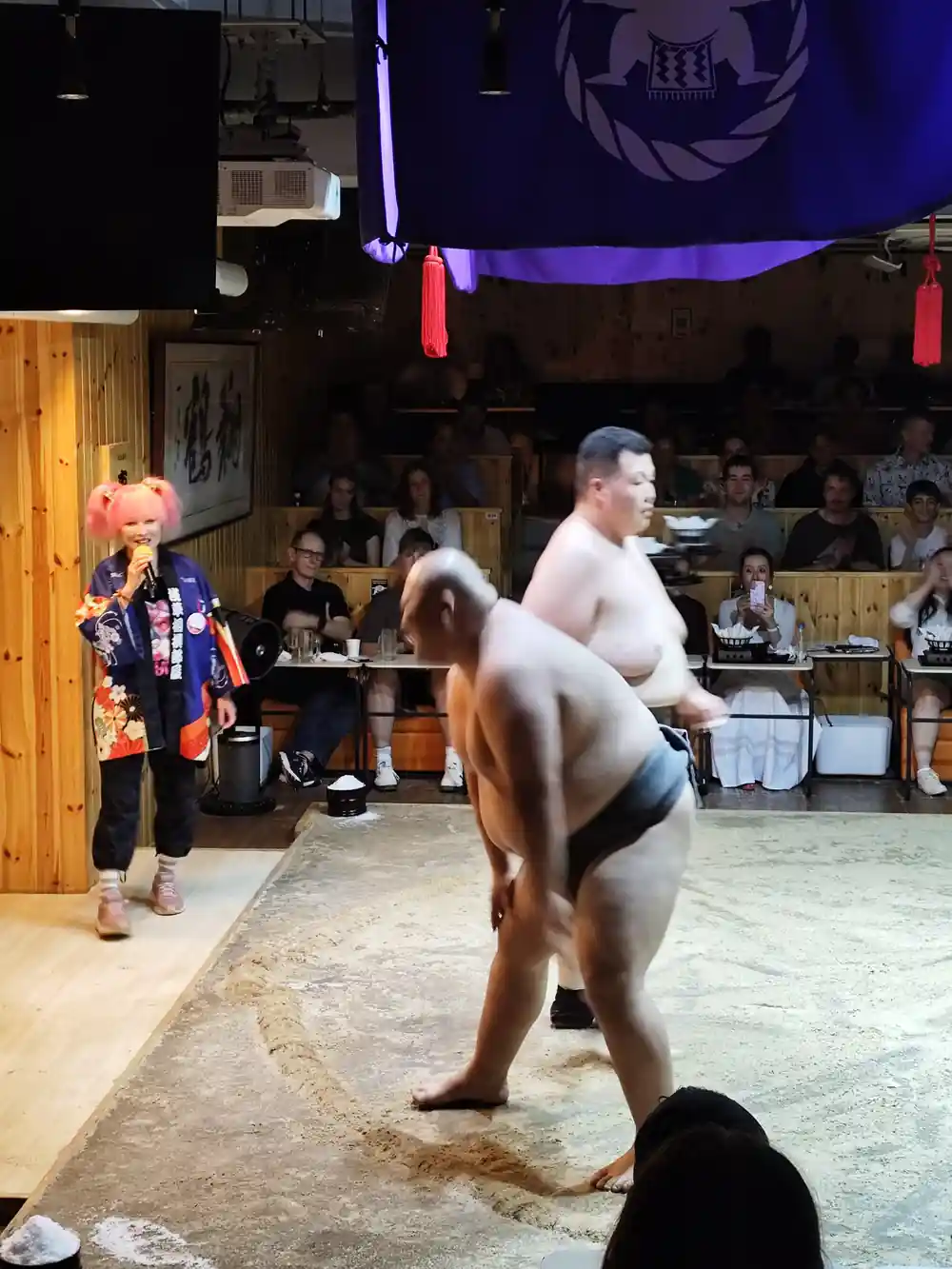
The ring looks far bigger on television. The sumo dohyō has a diameter of 14.93 feet (4.55 m),[3] and most of the drama happens in a space barely wider than two men standing side by side. Wrestlers throw salt, crouch, stare each other down, then collide. Sumo bouts last 20-30 seconds,[4] so a dozen fights can pass in the time it takes to drink a coffee. The robed referee, the salt, the stamping and the bow twirling between bouts are all part of the theatre around those few seconds of contact.
The rulebook is deep. The sport's official list runs to 82 kimarite, or match winning techniques and 5 non-techniques or ways to lose, all defined by Japan Sumo Association.[8] Nobody learns them in one morning. Some results still read instantly: a wrestler bundled over the edge, a leg hooked from nowhere, a slap down that ends the bout before the crowd has settled. If someone in your group already follows sumo, sit near them and ask questions quietly between bouts.
A Tokyo Sumo Stable Visit: How It Works
If a Tokyo sumo stable visit is the point of your trip, plan it around a guided morning practice tour rather than a show. These run to fixed schedules and usually include a short walk through Ryogoku with commentary on the way. One option visits Takasago-beya with an English guide, from US$95 and rated 4.70 from 398 reviews.[9] Another, a professional practice explained by experts, from US$90 and rated 4.84 from 77 reviews, is limited to 10 participants.[10]
House rules matter more than photos. Phones on silent, no flash, no eating, no wandering and no chatting while a bout is under way. Some tours build in a photo stop after training, which is the moment to ask. Shorter visits exist too, including a 2-hour practice tour with a ring-side seat, from US$95, that can be cancelled up to 24 hours in advance.[11] Wear socks without holes, since shoes stay at the door, and bring a bottle of water for afterwards.
from US$102
The Tokyo: Sumo Entertainment Show with Chicken Hot Pot & Geisha runs 2 hours, is wheelchair accessible and can be booked with free cancellation.[5]
Evening Shows and the Sumo Room
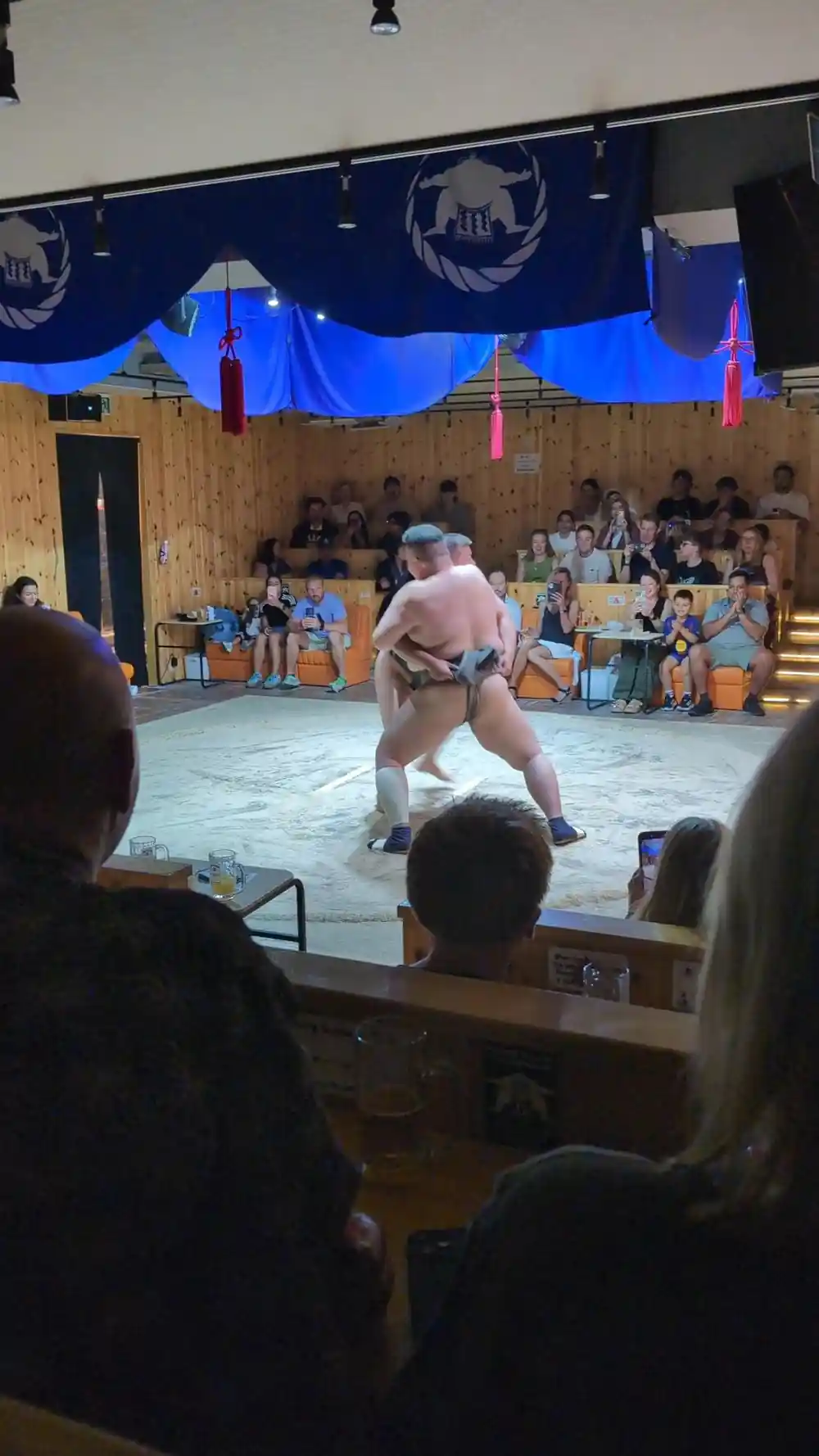
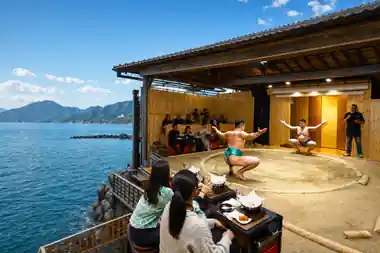
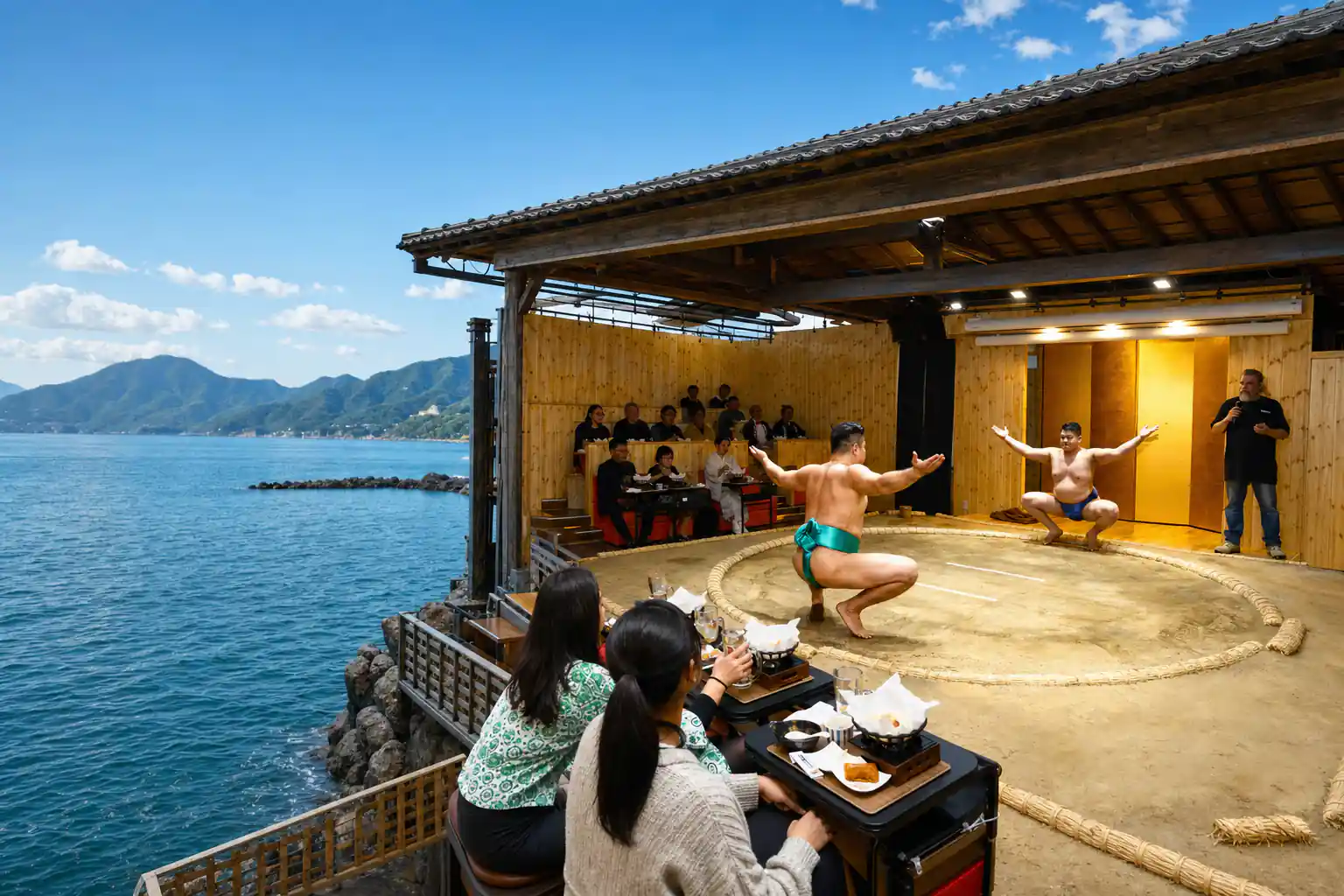
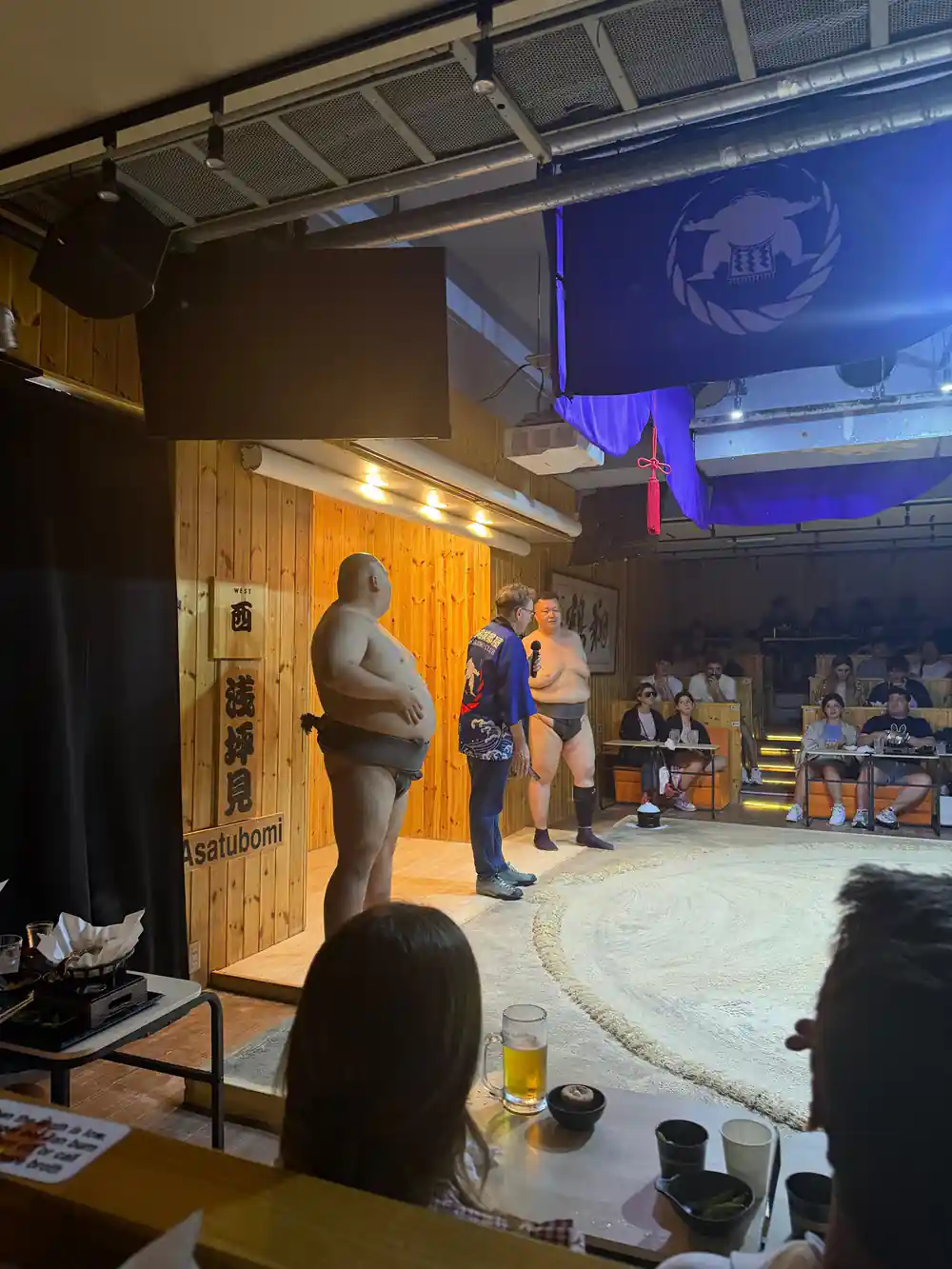
Evening shows are the easy option, and the one most travellers can book at short notice with a family in tow. Retired wrestlers perform on a ring inside a hall, explain each move in English, invite people up to try the crouch and the push, and pose for photos afterwards. It is loud, warm and simple to follow. Picture the Tokyo sumo room with cushions, a table and a microphone in front of it: the ring is real, the wrestlers are real, and the setting has been built for an audience rather than for training at dawn.
The tour booked from this site is the Tokyo: Sumo Entertainment Show with Chicken Hot Pot & Geisha, from US$102, rated 4.79 from 8,004 reviews and running 2 hours.[5] It has a small group available, is wheelchair accessible, and comes with free cancellation up to 24 hours in advance plus reserve now & pay later.[5] Two easier alternatives are the Tokyo: Family Sumo Workshop & Live Wrestling Show with Lunch, from US$62 and rated 4.90 from 430 reviews,[6] and the Tokyo Ginza Sumo Show: Live Performance & Photo Experience, from US$61, rated 4.57 from 1,459 reviews and running 1.5 hours.[7]
Chanko Nabe, Geisha and the Meal
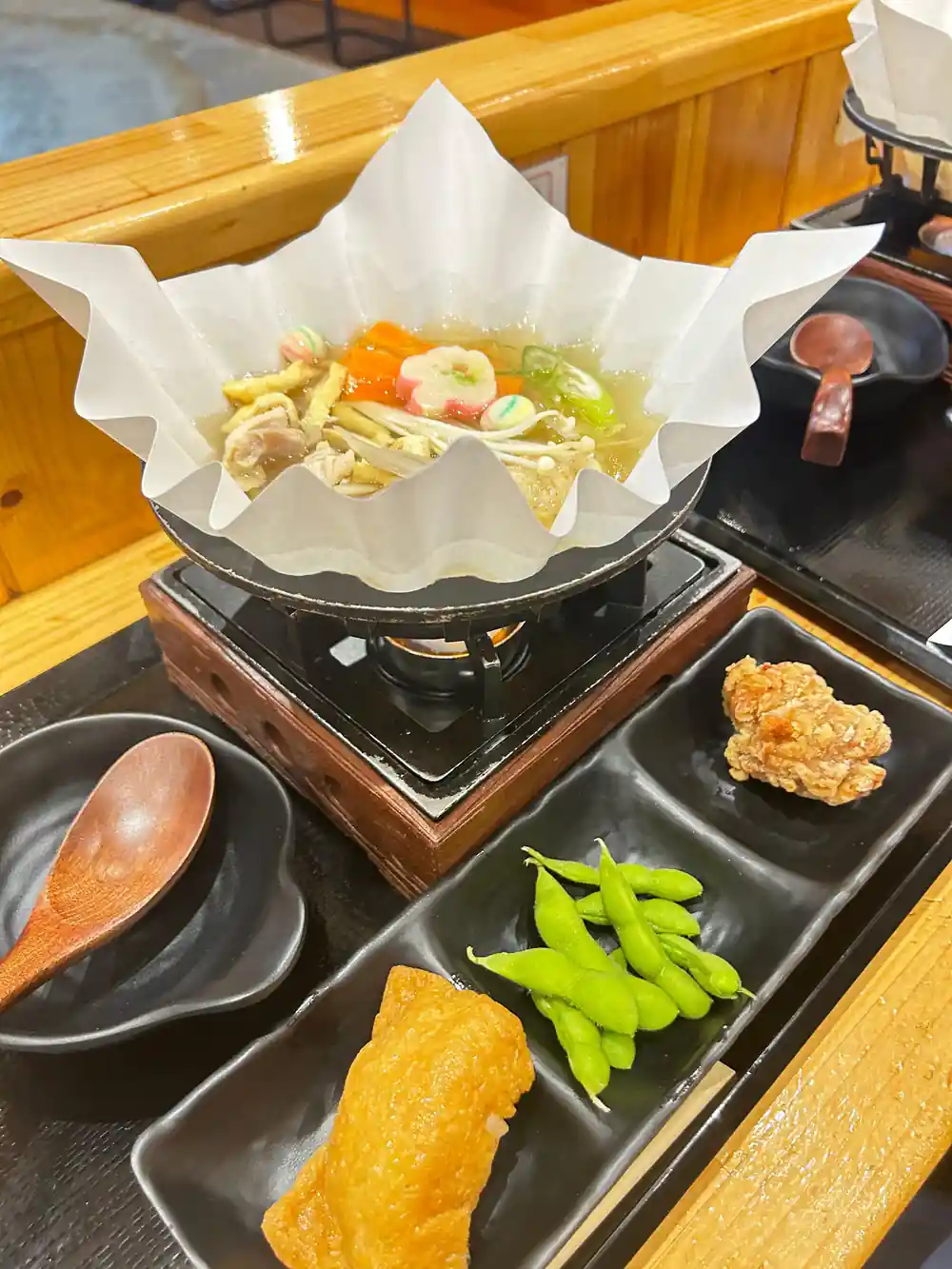
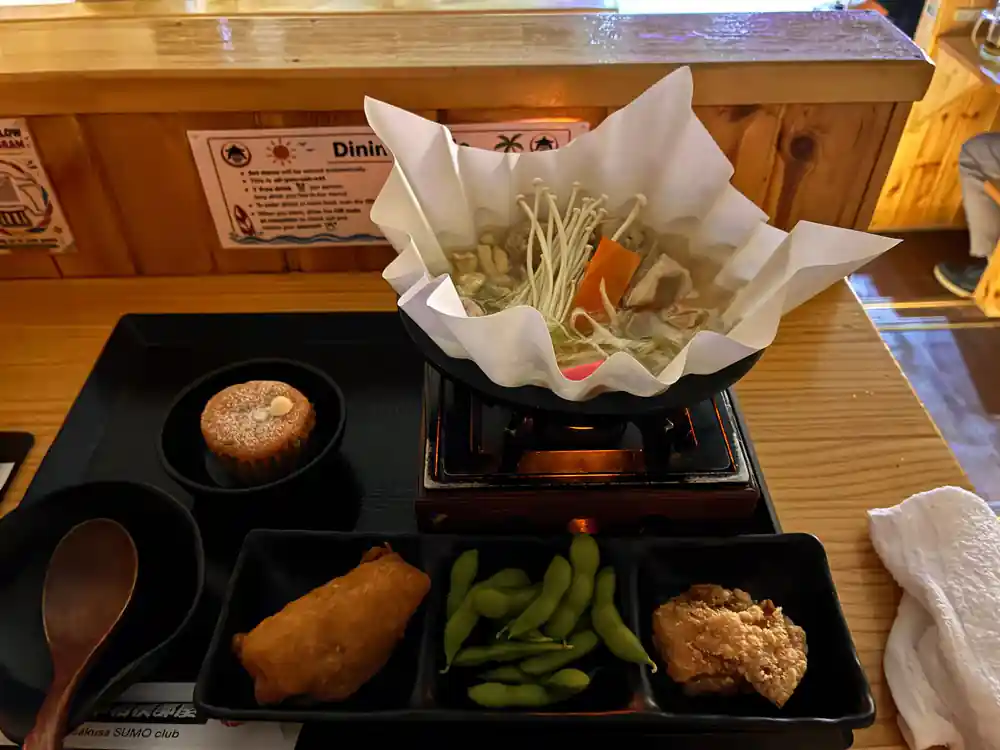
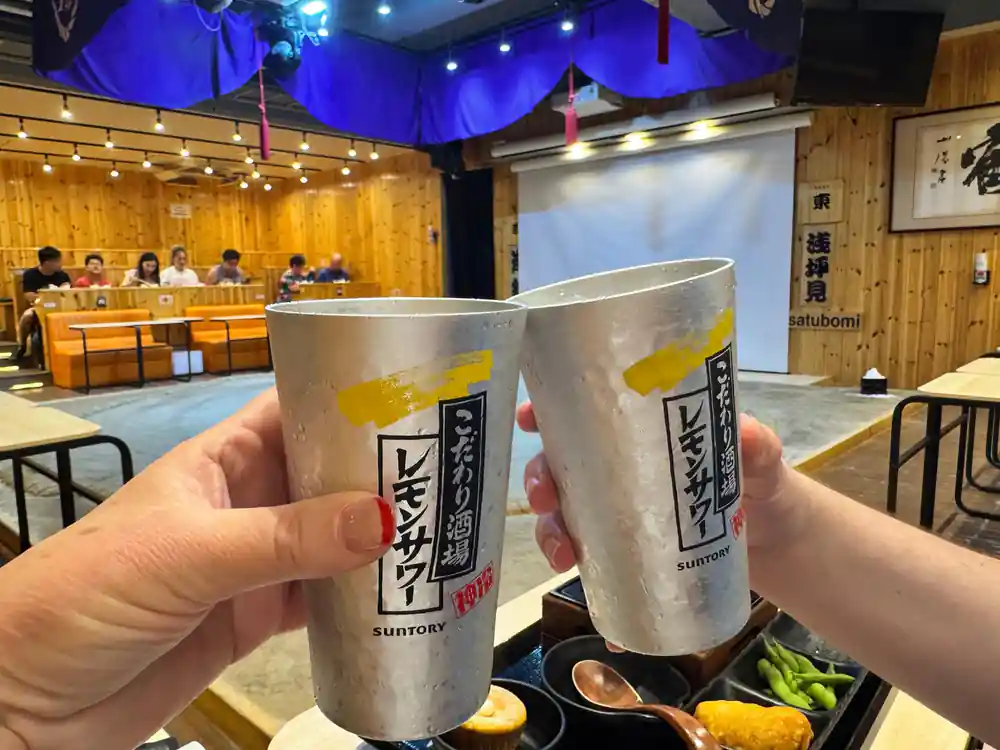
Chanko nabe is the food sumo made famous: a big pot of stock with chicken, vegetables, tofu and whatever else the stable has, eaten in serious quantities so wrestlers can add weight. The numbers behind that diet are startling. A modern Japanese sumo wrestler's optimal weight of between 400 and 600 pounds is sustained by a daily diet of 20,000 calories.[12] A study of 25 makuuchi wrestlers found they averaged 161.2 kg in weight and 186.3 cm in height.[13] At a show you get the flavour without the training load, and the hot pot is usually the highlight of the evening.
Some shows add geisha entertainment, and the contrast is part of the fun. A geisha's role is to make guests feel at ease with conversation, drinking games and dance performances.[14] On the Tokyo: Sumo Entertainment Show with Chicken Hot Pot & Geisha, the meal and the performance sit inside a 2 hour run,[5] which suits anyone who would rather eat and watch wrestling in one evening than organise two separate outings.
Tournaments, Seasons and Planning
If you want a Grand Sumo tournament rather than a show, the calendar is fixed. Six Grand Sumo Tournaments are held each year, in Tokyo in January, Osaka in March, Tokyo in May, Nagoya in July, Tokyo in September, and Fukuoka in November.[15] Tokyo's venue is the Ryogoku Kokugikan, which has a spectator capacity of up to 10,000.[16] Accessible seating is arranged separately: a wheelchair seat costs 8,000 yen and is for two people, a wheelchair user and one accompanying person.[17]
Outside those weeks the city still delivers. Morning practice runs at stables, shows run in halls, and you can build sumo around everything else you want to see. The sport itself is ancient. Historians agree that the origins of sumo date back 2,000 years, though it did not really flourish as a spectator sport until the early 1600s.[18] Its structure is neat: professional sumo is divided into six divisions, with Makuuchi as the top division containing 42 wrestlers.[19] Book what you can, and keep one early morning free.
How long Tokyo sumo bookings last
Durations as listed on GetYourGuide for the cited tours:[5][6][7][20]
USD from-prices per person
US dollar from-prices per person for the tour listings cited:[5][6][7][21]
When to book what
How to plan your visit
Pick your format
Choose between a real morning practice visit and an evening show with food, geisha and demonstrations. The two suit different appetites and very different alarm clocks.
Check the calendar
Look at the tournament months first, then at what else is running. Ryogoku is busiest when the Kokugikan arena is in use.
Book and confirm
Reserve online, save the meeting point, and note the cancellation window in case your plans shift.
Learn the etiquette
Shoes off, phones silent, no flash, no eating, no wandering. Sit still and let the guide tell you when you can move or take a photo.
Fill the rest of the day
Pair an early practice visit with a late breakfast in Ryogoku, or an evening show with a walk along the river afterwards.
See the Tokyo sumo show with hot pot and geisha
from US$102Reserve now & pay later